News
The Precision of One Degree. Guenther Polska on Developing Thermocouples for Demanding Industrial Processes
One Degree Makes a Difference
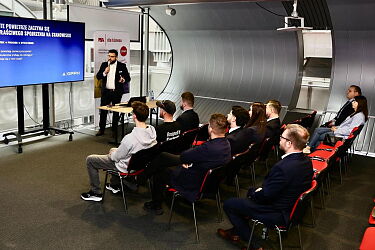
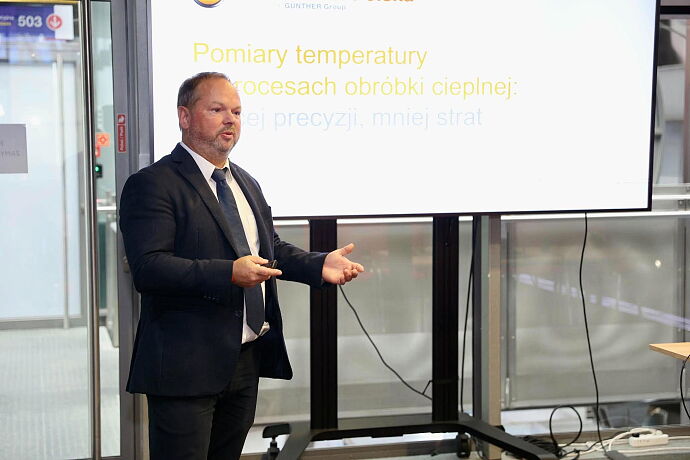
Precision heat treatment is placing ever greater demands on manufacturers of measuring equipment. During the presentation, particular attention was drawn to the highly demanding processes used, among other sectors, in the aerospace, automotive, energy and medical industries.
The requirements applied in the aerospace industry provide a good example. As highlighted during the presentation, the AMS 2750 standard requires a very high degree of temperature measurement accuracy, while successive changes to the requirements are leading to increasingly tighter permissible deviations.
For sensor manufacturers, this means not only producing a thermocouple with the required parameters, but also confirming its accuracy through the calibration process.
Guenther Polska and Wrocław University of Science and Technology Join Forces
Guenther Polska is developing a project focused on the serial production of its own high-accuracy Type S, R and B thermocouples. The company has joined forces with Wrocław University of Science and Technology, whose experts are supporting the research and development work.
The project is being carried out in several stages. It includes materials research, simulations, machine learning, analysis of the manufacturing process and the prototyping of a technological test rig. The aim is to develop a process that will make it possible to manufacture precision thermocouples faster, with greater repeatability and, ultimately, make them more accessible to customers.
Although the operating principle of a thermocouple may seem straightforward, at high temperatures, accuracy depends on the smallest details. Factors such as the way thermocouple wires are joined and prepared, as well as the insulating materials used, can all make a difference. At high temperatures, elements can also migrate between materials, potentially affecting the thermocouple’s characteristics and, consequently, its temperature reading.
A Digital Twin of the Laboratory
One of the more interesting elements of the project is the proposed use of a digital twin of the laboratory, developed by Wrocław University of Science and Technology. The solution is intended to support analysis of the calibration process and enable potential irregularities to be identified more quickly.
The work involves collecting data on, among other things, the behaviour of the laboratory furnace at different temperatures and with different numbers of sensors being calibrated. Phenomena associated with heat convection and thermal radiation are also analysed. The actual data are then compared with the results generated by the models and algorithms being developed.
This has very practical implications. As explained during the presentation, calibrating a single thermocouple can take as long as 12–24 hours. If the system can identify after just a few hours that a process is not proceeding correctly, it could save valuable time and allow the necessary adjustments to be made more quickly.
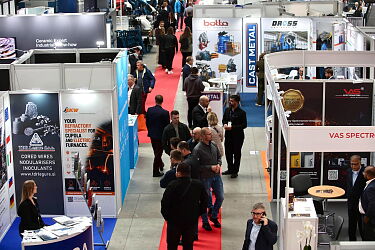
Guenther Polska’s presentation fits well with the profile of the trade shows, where measurement technologies are presented not only as finished products, but also as part of increasingly sophisticated manufacturing processes. The combination of metrology, materials research, modelling and machine learning demonstrates how approaches to temperature control are evolving for the most demanding industrial applications.
Recommended articles