News
From modems taken to customers to electronic keys. How technology is transforming the window and door industry
During the inaugural edition of WinDoGlass Innovation at Expo Kielce, Winkhaus Polska presented two technological strands of its business. The first was WH Okna, a solution developed over the past 30 years to support window and door manufacturers with design, costing and production management. The second was blueEvo electronic access control, which adds access-rights and access-information management to mechanical security.
From fax machines and modems to the entire production process
The beginnings of WH Okna date back to a time when customer orders were sent to companies by fax. As Janusz Grześkowiak, Technical Manager at Winkhaus Polska, recalled, the first steps towards digitalisation involved not only developing the necessary IT solutions, but also preparing customers to use them.
“Our IT specialists used to travel to customers with modems. They installed the modem so that orders could be sent to us via the internet,” Janusz Grześkowiak recalled.
He remembers his own early days with the Polish subsidiary from a time when, as a technician, he travelled in his private Fiat 126p, with his entire set of tools taking up the back seat. At the time, the company employed just a handful of people and was rapidly expanding its operations.
Today, the scope of WH Okna is incomparably broader. The software supports the process from preparing a quotation and designing a window, through costing and production, to storage, assigning the finished product to the appropriate stillage and vehicle, and finally dispatching it to the dealer.
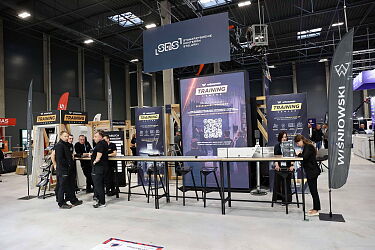
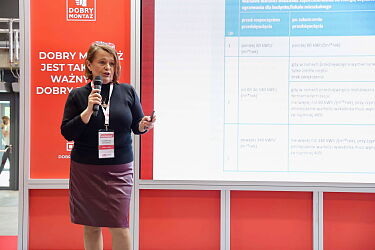
The system’s practical nature was also evident during a training session at Expo Kielce. Users asked questions about, among other things, configuring HST constructions and calculating installation costs using data transferred to an Excel spreadsheet. The trainers worked directly in the software, resolving issues raised by manufacturers.
Before building a new production hall, analyse your production
The software itself is only part of the support offered to manufacturers. Winkhaus also analyses and optimises production processes – from organising individual workstations and sequencing operations to determining the plant’s actual capacity and workload.
According to the Winkhaus team’s experience, simply organising workflows more effectively can increase productivity by 20–30 per cent at many companies, without the need to invest in another production hall or production line.
“It is often the case that a company owner thinks about building another hall because they cannot keep up with demand. Once the processes have been optimised, it turns out that the new hall and production line are not necessarily needed,” Janusz Grześkowiak said.
The mechanics remain, but technology has moved on
Kamilla Los-Marszałek, Senior Marketing and PR Specialist at Winkhaus Polska, stressed that the development of electronic solutions does not mean moving away from traditional hardware. Window and door hardware and access-control systems remain two parallel areas of the company’s business.
What is changing, however, are users’ expectations. Technologies that were once considered innovative have now become standard, while additional functionality, security and the ability to combine mechanical and electronic solutions are becoming increasingly important.
An electronic key that carries information
The second solution presented at WinDoGlass was the blueEvo electronic access-control system. Andrzej Andrzejewski, Market Development Manager for Security Systems at Winkhaus Polska, explained how it works using a conventional door as an example. A mechanical cylinder can be replaced with an electronic one operating within a system in which keys or cards also serve as information carriers.
The solution is primarily intended for organisations with a large number of access points. It can also be installed in existing buildings and expanded gradually.
One of its features is the ability to operate independently of continuous access to the computer network and the building’s power supply.
“If we lose control of the LAN or the power supply, the system continues to operate – it works independently,” Andrzej Andrzejewski explained.
Solutions of this kind can also be used across dispersed sites. Andrzejewski cited wind farms and water intakes as examples. The system also allows checking the history of access-related events at protected locations.
The padlock that only looked locked
Andrzej Andrzejewski also gave an example showing that security problems do not always begin with a lack of advanced technology. At one customer’s site, a gate was secured with a chain and padlock. From a distance, everything appeared to be in order. Only on closer inspection did it become clear that the padlock was secured around the chain itself, while the gate was, in reality, still open.
It is a simple illustration of the difference between the appearance of security and genuine access control. From organising production to controlling who can enter a protected room and when, technology is increasingly taking over functions where, three decades ago, a paper order, a mechanical key and a padlock were all that was needed.


(BB)
Recommended articles