News
Wax on a tombstone? Not everyone hides the candle inside a lantern
Have you ever found a hardened smear of paraffin wax on a headstone? All it takes is a leaky insert, a cracked grave candle or a lantern that has tipped over. The result is an unsightly mark on the polished slab, and getting rid of it can be a nuisance.
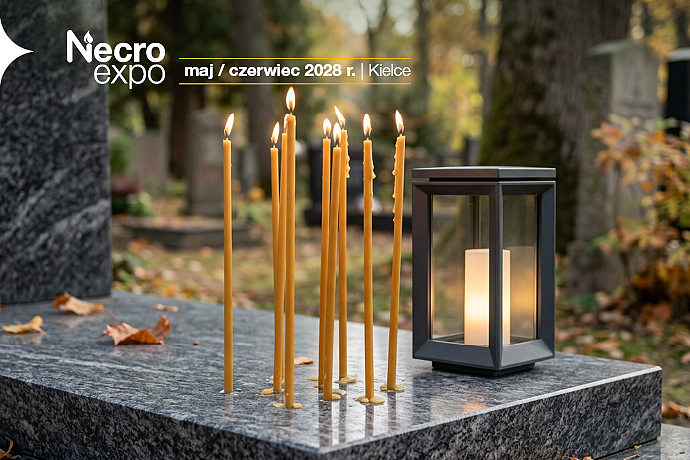
In Poland we are used to a flame enclosed behind glass, sheltered from wind and rain. However that is not the only way to light up a grave. In parts of Eastern Europe and the Balkans, slender, unprotected candles are set in holders or candlesticks, or pushed straight into the soil beside the grave.
Candles, wheat and wine. How are the dead remembered in the Balkans?
In Serbia, on the Orthodox days of remembrance known as Zadušnice, families visit cemeteries, light candles and bring offerings such as boiled wheat and wine. Similar rites are found in Romania, Moldova and Ukraine, though they vary from region to region and with local tradition.
Moldova has kept a particularly distinctive custom for Paștele Blajinilor, a post-Easter feast in memory of the dead. Families gather in cemeteries, priests say prayers and relatives share food.
The Moldovan news agency Moldpres describes one more striking detail: women bring towels with candles attached and hand them to the priests, who read out the names of the departed during the prayers.
It is a far cry from the rows of ornate glass grave lanterns we are used to in Poland.
That is not to say, of course, that people in these countries do not use lanterns. Modern grave lights, traditional candles and oil lamps all exist side by side there. The differences between neighbouring villages can be greater than those between countries.
A light that accompanies prayer
In the Orthodox tradition, a lit candle is a sign of prayer and of remembrance of the departed. The flame symbolises the light of Christ and the hope of resurrection.
What matters is the gesture itself: pausing at the graveside, lighting the wick, a moment of prayer. A candle need not burn for days on end to fulfil its symbolic role.
In practical terms, of course, a thin, unshielded flame is far more exposed to the wind. Dripping wax can also leave a mess around the grave. Yet the form in which the light is lit does not carry the same weight everywhere as it does in the Polish cemetery tradition.
In Lviv, candles were cut in half
An intriguing picture of changing customs comes from the November 2011 issue of Kurier Galicyjski.
In an article on All Saints' Day and All Souls' Day in Lviv, the author recalls a time when the graves there were visited mainly by Poles and glass grave lanterns were still uncommon. Paraffin candles were cut in half back then, and several were lit on each grave.
Over time, the face of Lychakiv Cemetery changed. One contributing factor was the "A Light of Remembrance for Lychakiv Cemetery" campaign, which brought thousands of grave lanterns over from Poland. In 2011, the eighth edition of the campaign collected 35,000 of them.
It is a striking example of how a cemetery landscape can change in just a few decades. The old custom of lighting a flame has not disappeared, but its setting has changed.
A real flame or an LED light?
Today we face another choice. Traditional paraffin and oil inserts increasingly share headstones with their electronic counterparts.
With an ordinary grave candle, you have to stop for a moment. You shield the flame from the wind, bend over the wick and make sure the light will not go out. An electronic insert requires none of these gestures. A flick of a switch is enough, and some models even switch on automatically at dusk.
Fans of LEDs value the convenience. There is no wick to light and no spilt wax to worry about. In return, however, the batteries need replacing or recharging – or, with single-use models, a new insert has to be bought.
Then there is the environmental question. At the end of October, the Ministry of Climate and Environment reminded the public that spent LED and solar grave lights count as electronic waste. They must not be thrown into ordinary household bins. They should go to designated collection points, and the batteries, if they can be safely removed, into separate containers.
Durable lanterns, replaceable inserts and sensible waste management matter whichever kind of light we choose. One kind of light calls for matches and a moment's patience. The other – for batteries or a rechargeable cell. For some, the ritual of lighting the wick remains important; for others, it is the convenience and longevity of an electronic lamp. Either way, it is the same gesture of remembrance.
(BB)
Recommended articles