News
Coffins for pudding? The Czechs see nothing odd about it
Little coffins with whipped cream, little wreaths with custard
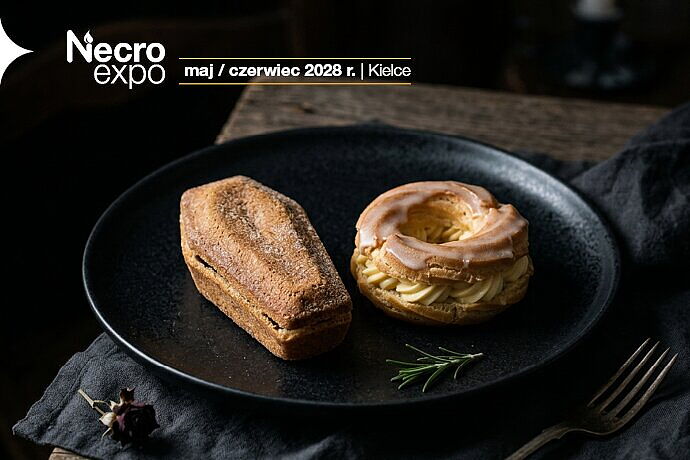
You walk into a Czech patisserie, scan the display cabinet and there, alongside the gateaux and pastries, sits a row of little coffins. You can order one, two or even a whole box. And add a little wreath to complete the set. So what do our southern neighbours' pastries really look like? You can see them in the photo galleries of Czech patisseries, but there are so many variations that you could fill a whole week of afternoon teas with them:
coffins and funeral wreaths.
Rakvičky se šlehačkou – little coffins with whipped cream – are a classic of Czech confectionery. They are made from whisked egg yolks and sugar, usually flavoured with vanilla. The mixture is baked in special moulds shaped like tiny coffins. As it bakes, it rises into a hollow, exceptionally crisp shell, which is then topped with a generous helping of whipped cream.
The věneček, or little wreath, looks much like the choux ring well known in Poland as a gniazdko ("little nest"), also called a Viennese or Spanish doughnut. Both are made from choux pastry, but the Czech version is baked rather than fried, then filled with custard, usually egg-yolk or vanilla. The top is usually finished with a pale, sweet glaze.
A coffin and a wreath? The funeral connotations are obvious, although the Czech věneček simply means a small wreath or garland. The two pastries are also sold separately, but their names make perfect material for wordplay.
"Do you want a little wreath or a little coffin?" — the father asks his son
This confectionery dilemma has even made its way into Czech film history. In the 1969 film The Cremator (Spalovač mrtvol), crematorium worker Karel Kopfrkingl, played by Rudolf Hrušínský, turns to his son and asks:
„Tak co, chceš věneček, nebo rakvičku?”, i.e.: "Do you want a little wreath or a little coffin?"
Coming from a man who hides murderous intent behind the mask of a caring father, an innocent question about a cake takes on a sinister meaning.
Directed by Juraj Herz and based on the novel by Ladislav Fuks, the film was shot in 1968 and premiered in March 1969. It remains one of the best-known works of Czechoslovak cinema, blending psychological horror, the grotesque and black humour.
Who invented the sweet little coffins?
The question even caught the attention of the National Library of the Czech Republic. In 2015 its staff tried to establish when this distinctive pastry first appeared. They searched old cookery books, dictionaries and historical studies, but found no definitive answer.
What is known is that the little coffins were already around in the first half of the 20th century. Their name most probably comes from the shape of the baking moulds.
An even earlier clue leads to Turnov. Vladimíra Jakouběová, a researcher of regional traditions, cited on Czech Radio a recipe for vanilla coffins from the early 20th-century recipe collection of Jína, a local confectioner.
The name věneček, on the other hand, already appeared in 19th-century Czech cookery books, including those of Magdalena Dobromila Rettigová. Recipes of that era, however, referred to other ring-shaped bakes, not necessarily the same as today's custard-filled wreaths.
Who first had the idea of giving a sweet pastry the shape of a coffin? That remains a mystery.
For All Souls' Day, people even baked bones
Linking baking with death is nothing new in the Czech lands. Old All Souls' customs offer even more surprising examples.
In some villages of the Pojizeří region, for All Saints' Day and All Souls' Day – known in Czech as Dušičky – people made special breads called dušičky or kosti: "little souls" and "bones".
The bakes took the form of crossed bones, plaits, rolls and crescents. They were taken to graves, given to the poor and to travellers, and handed out to children going from house to house. Sometimes they were served as the final course of the festive meal.
There is no evidence that today's patisserie coffins descend directly from this custom. Yet these old recipes are a reminder that food has accompanied rites of remembrance for centuries.
Black humour with a sweet twist
In the Czech Republic, rakvičky and věnečky are not reserved for Halloween or the November holidays. They are on sale all year round. To many Czechs they are simply traditional pastries, as ordinary as éclairs or cream slices are to Poles.
So this time, in search of funeral curiosities, we called in not at an undertaker's but at a Czech patisserie. And along the way, we revisited a classic of Czech cinema.
If you are heading south across the border, do order a little coffin with whipped cream. And perhaps a little wreath too?
As for the best-before date? Best not to leave it until eternity.
(BB)
Recommended articles