News
Uncrewed aerial vehicles on land and at sea – WB Group announces a "multi-domain revolution"
"Future Task Force" – a new generation platoon
The "Future Task Force" concept is the focal point of the WB Group exhibition, i.e. a platoon of the future in which manned and unmanned systems cooperate. The core of the group is to serve as a command vehicle, acting as a mobile operations centre composed of a variety of platforms – from land robots capable of reconnaissance and fire support to autonomous surface vehicles for patrol operations or critical infrastructure protection.
This system allows for complete flexibility of configuration – the commander can use a manned combat vehicle in missions requiring direct action, or replace it with a fully autonomous unit if minimising risk to soldiers is a priority.
Domain Integration – from Air to Land to Sea
The WB Group emphasises that the new generation of its solutions is not limited to single platforms; the multi-domain ecosystem is the key. All elements – aerial drones, surface units, and land vehicles – operate within a unified command and communications architecture.
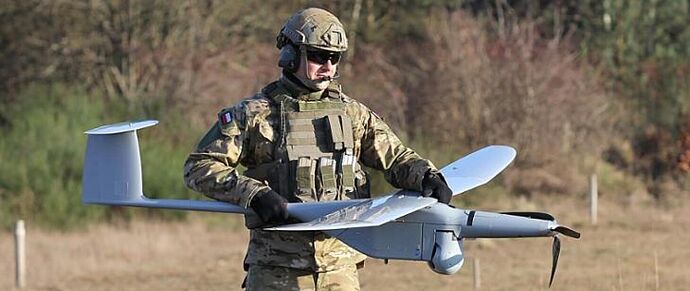
The company has been developing technologies of this class for years. The FlyEye, FT-5, and Warmate systems have become recognisable around the world and have proven their worth in real operational environments. Now, land and sea drones are joining this portfolio, building a coherent set of tools for the army of the future.
Multi-Domain Command and Communications
Communications and battlefield management are equally important elements of the revolution - the WB Group emphasises that the military advantage does not result solely from having modern drones, but from the ability to integrate them in real-time.
The new systems will enable the synchronisation of operations in multiple environments – soldiers will be able to simultaneously use reconnaissance images from an aerial drone, data from an autonomous patrol boat, and support from an unmanned combat vehicle. All this will be integrated within our own encrypted communication networks, which will significantly enhance the security of the information transmitted.
Challenges and importance for Poland's security
The development of unmanned technologies also has a strategic dimension and by investing in WB Group systems, the Polish Army gains an advantage in deterring and responding to hybrid threats – from border protection, through securing critical infrastructure in the Baltic Sea, to participation in NATO allied missions.
Multi-domain also aligns with the latest global trends – the armies of the United States, Great Britain, and Turkey are consistently investing in the integration of forces across all operational environments. The presence of the WB Group at MSPO 2025 shows that Poland is becoming an active participant in this global technological revolution.
/MBrz/
Recommended articles