News
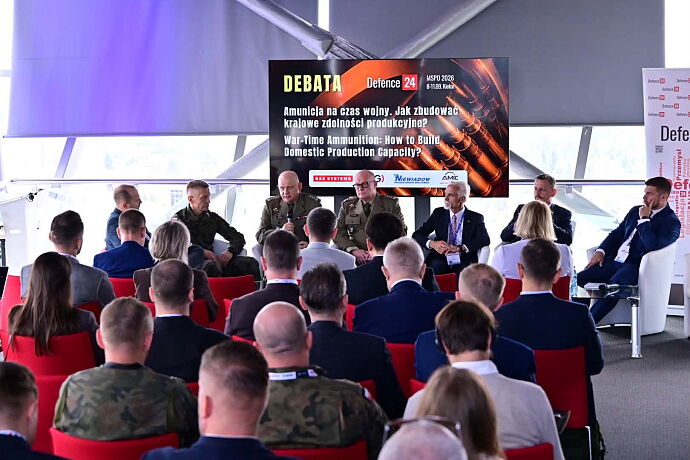
On 10 September, Targi Kielce became a hub for wide-ranging discussions on how to build Poland’s and Europe’s defence capabilities – not only through the procurement of equipment, but also by developi
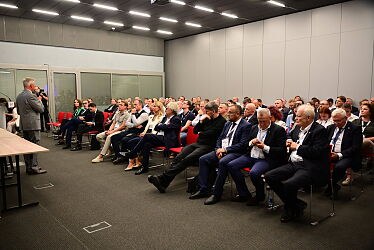
The debate, entitled “Ammunition for Wartime. How to Build Domestic Production Capacity”, was held during this year’s International Defence Industry Exhibition at Targi Kielce. Organised by Defence24.pl, it brought together representatives of the Polish Armed Forces, the National Security Bureau and the Polish and European defence industries. Discussions focused not only on the quantities of ammunition required, but also on production capacity, the security of raw material and component supplies, and the need to adapt ammunition to a rapidly changing battlefield.
Ammunition as Part of the Wider Fires System
As Maj. Gen. Adam Rzeczkowski, Head of the Department for Oversight of the Armed Forces at the National Security Bureau, pointed out, experience from modern conflicts shows that the focus cannot be placed on a single type of weapon. – The complementary and coordinated use of all available means of firepower, from deep and precision strikes to tactical-level effects, together with efforts to saturate the adversary’s defence systems, is the only way to defeat the enemy effectively – he said.
Gen. Rzeczkowski also referred to decisions taken following the 2023 NATO Summit in Vilnius, highlighting the link between the Alliance’s new operational planning architecture and the need to significantly increase both ammunition production and stockpiles.
The Military Is Planning for the Long Term
Col. Wojciech Dalka, Chief Specialist at the P5 Directorate of Planning and Programming for the Development of the Armed Forces, General Staff of the Polish Armed Forces, stressed that the development of the Polish Armed Forces and their ammunition requirements must be treated as a single, integrated process. The expansion of military units and acquisition of additional weapons systems inevitably generate greater demand for ammunition.
– Our guiding mission is to build the greatest possible national capability in this area. We need to be self-sufficient, maintain defined stockpiles for wartime, and also have the capacity to produce ammunition ourselves – Col. Dalka said.
As he explained, the development of the Armed Forces is planned over a multi-year horizon. This planning covers not only equipment, structures and units, but also the ammunition requirements generated by their operation.
Drones Can Be Jammed. Artillery Shells Are Far Harder to Stop
The lessons of the war in Ukraine were also highlighted by Col. Jacek Żołnowski, Head of the Military Equipment and Development Division at the Directorate of Rocket and Artillery Forces, General Command of the Branches of the Polish Armed Forces. He stressed that the rapid development of unmanned systems does not diminish the role of conventional artillery.
– A drone can be disrupted or shot down in one way or another. An artillery shell fitted with a conventional impact fuze, however, cannot be stopped once it has been fired. Even if one or two shells can be intercepted, a battery salvo cannot be stopped – Col. Żołnowski said.
The military also expects ammunition capabilities to continue to improve, particularly in terms of range and precision. This includes solutions capable of reaching 40, 50, 60 kilometres and beyond, as well as fuzes allowing the trajectory of a projectile to be corrected while remaining resistant to electronic interference.
The colonel also stressed the importance of ammunition quality, consistency between individual production batches and appropriate training. – What the industry provides accounts for 50 per cent of our capability. If the projectile is properly prepared, we do the rest – and all those projectiles reach their intended targets – he said.
Poland’s 155 mm Ammunition and the Race to Keep Pace with Technology
Adam Januszko, President of the Management Board of Niewiadów Polska Grupa Militarna S.A., spoke about the need for industry to respond rapidly to changing military requirements. He noted that the company is developing domestic solutions and production capabilities for 155 mm ammunition.
He also highlighted the exceptionally rapid pace of technological change observed during the war in Ukraine. Solutions that until recently could remain effective for several months may now, particularly in the field of unmanned systems, require modification within just a few weeks.
In these circumstances, the defence industry must not only increase production volumes but also retain the ability to adapt products rapidly to the latest battlefield requirements. As Adam Januszko stressed, developing Polish technologies and maintaining production capacity domestically are also important factors in strengthening security in wartime conditions.


A Factory Alone Is Not Enough. The Entire Supply Chain Matters
Przemysław Kowalczyk, President of Grupa Polski Pierścień Amunicyjny, highlighted the importance of supply chain security. As he noted, modern ammunition production relies on an extensive network of manufacturers, component suppliers and subcontractors.
– There is no longer a situation in which a single manufacturer, however large, produces everything from A to Z – Przemysław Kowalczyk said.
He stressed the need to diversify both customers and sources of supply. The industry must invest in new production capabilities for components and finished products while also building a system capable of withstanding crises.
The experience of the COVID-19 pandemic demonstrated how quickly even well-functioning supply chains can be disrupted. New production models should therefore incorporate redundancy in the supply of raw materials, materials and components.
“Europe Has To.” Domestic Production Means Security
The need to build Europe’s own industrial base was highlighted by Łukasz Malicki, Chief Operating Officer at CSG / Czechoslovak Group. He pointed out that ammunition security does not begin on the assembly line for the finished projectile. Steel, TNT, propellants, nitrocellulose and a range of other materials and components are all required.
CSG is therefore developing a vertically integrated model designed to secure successive stages of the production chain and expand its capacity to manufacture artillery ammunition.
– Europe has to. We have to manufacture here. We need these components. We have to look at the security of the region. We cannot wait – Łukasz Malicki stressed.
As he noted, European countries should strengthen regional cooperation and develop solutions that allow sources of supply to be substituted for one another when necessary. The ability to rapidly scale up production in response to a sudden surge in demand is equally important.
The War in Ukraine Has Changed the Way We Think About Ammunition
The experience of the war in Ukraine was the common thread running through the debate. It has demonstrated both the enormous scale of ammunition consumption and the importance of stockpiles, production capacity, secure supply chains and the ability to adapt technologies rapidly to new threats.
As the participants stressed, having modern weapons systems alone is not enough. They must be backed by adequate ammunition stocks, well-trained personnel and an industrial base capable of sustaining production and, when necessary, rapidly scaling it up.
The debate “Ammunition for Wartime. How to Build Domestic Production Capacity”, organised by Defence24.pl, was held on 10 September during the International Defence Industry Exhibition MSPO 2026 at Targi Kielce.
(ŁK)
Recommended articles