News
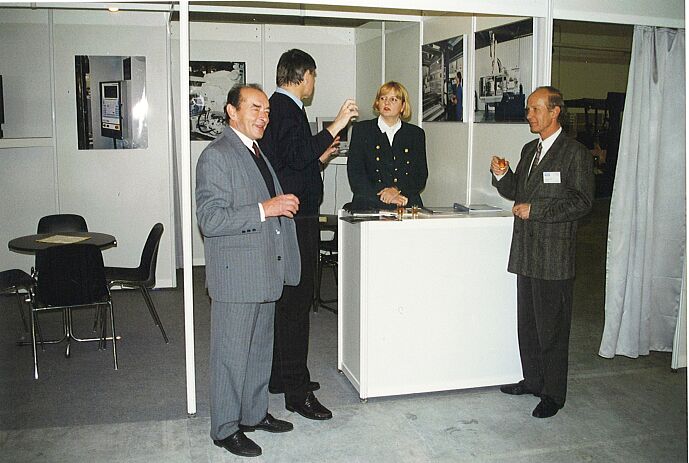
It all began with a VHS player behind a curtain – 30 years of Plastpol through the memories of Dopak
The beginnings of Plastpol Expo: courage and vision
When the first Plastpol was held in 1997, no one was yet speaking of international standing or European rankings.
– We had an Expo Hall at our disposal, which was then a warehouse for construction materials. The space was separated by a curtain, and we rented 20 m² behind the warehouse, says Szczepan Kawa. - We assembled the expo stands ourselves until late hours, with plenty of improvisation.
The technology on show was already almost pioneering back then. Instead of machines working live that we see live today, there was a film on a VHS tape. Instead of extensive expo stands, there were improvised spaces. However, companies saw the potential and believed that specialised industry fairs have a future in Poland.
The Challenges of the 1990s: Logistics, Energy, and Determination
The subsequent Plastpol expo showed how difficult it was to organise an international event at that time. One of the biggest challenges was customs clearance.
– During the second show, we already showed the machines, but there was a problem with customs clearance. Trucks with equipment waited for weeks; there were no officers to work on holidays or during training. After numerous interventions, we managed to get the machine into the expo hall – recalls Director Kawa.
The technical infrastructure was equally demanding.
– The machines are energy-intensive, so we worked in shifts. I requested a generator from Targi Kielce – and we got it. During one of the power supply cuts, he kept our stand's power supply running. We used to say with a smile, “Buy Dopak machines – they work even without electricity,” he adds.
![foto-1.jpg [3.56 MB]](https://www.targikielce.pl/storage/image/core_files/2026/5/6/2da6298359921beaf141180132707ffe/default/preview/foto-1.jpg)
Creativity instead of limitations
The lack of exhibition space quickly became another driver for unconventional solutions.
– There were only two expo halls at the beginning, and there were more registrations than places. I commissioned Mostostal to build a two-story platform – approximately 120 m²; upstairs, we had a meeting space, downstairs, we presented the machines, says Szczepan Kawa.
The platform became a symbol of those times – courage, improvisation, and the belief that limitations can be turned into advantages.
Professionalisation and breakthrough of the Plastpol trade fair
![DOPAK-Szczepan-Kawa.jpg [106.65 KB]](https://www.targikielce.pl/storage/image/core_files/2026/5/6/a10d774cb8e2978e0fd95a4eb215618d/default/preview/DOPAK-Szczepan-Kawa.jpg)
Against the backdrop of other trade fairs in Poland in the 1990s, Plastpol distinguished itself from the outset with a clearly defined specialisation. – It was the first professional industry trade fair in Poland. Previously, there was chaos – our stand could be placed next to completely random displays, such as axes and ropes. In Kielce, everything was in order from the very beginning, emphasises Szczepan Kawa. - The idea was coordinated by Professor Henryk Zawistowski, an industry authority and an outstanding scientist.
Poland's accession to the European Union was the turning point.
– Then, organising stands and transporting machines became really simple – he notes.
Plastpol - the stage for innovation
The trade fair quickly became a venue for technological premieres.
– We were the first in Poland to showcase here, among others: IML, i.e. injection with an in-mould label, water injection, technologies using nitrogen or the production of composite elements, e.g. car airbags. We still have them in our laboratory in Wrocław - reports Szczepan Kawa. - Plastpol means more than just machines. The show means relationships, exchange of experiences and new contacts.
A new era and the development of Targi Kielce
Another important moment in the history of the trade fair was the organisational changes and dynamic development of the centre itself.
– We began a new era when the president of Targi Kielce, Andrzej Mochoń, and Kamil Perz, director of the Plastpol project, became very involved. They are fantastic people, with whom cooperation is exemplary, emphasises Szczepan Kawa.
– Today, Targi Kielce is undoubtedly the most important exhibition centre in Poland, thanks to events such as Plastpol.
The international meeting centre for the whole sector
Plastpol itself has established its position in Europe. – There is no other event like this in this part of the continent – says Szczepan Kawa.
The changing market is strengthening the role of Central and Eastern Europe, and the Kielce trade fair is becoming a natural meeting point for the industry.
![DOPAK-Joanna-Janczy.jpg [102.86 KB]](https://www.targikielce.pl/storage/image/core_files/2026/5/6/8c9149db8a38c670bbb3739ae9d63e6c/default/preview/DOPAK-Joanna-Janczy.jpg)
– We do not limit ourselves to Poland – we operate throughout Europe and beyond. Our offer also reaches foreign clients – emphasises Joanna Janczy, marketing manager at Dopak. – The internet has changed communication, but in our industry, live shows are key. Every year in Kielce, we meet companies that we did not know before, which is very valuable. We can get to know them, show them what they offer, and start a collaboration. We are now increasingly turning our attention to Eastern Europe, although Germany remains an important market.
Plastpol's journey – from expo stands separated by curtains to modern halls and global reach – shows how a consistently built event can become a pillar of the entire industry.
Today, Plastpol is a platform for meetings, knowledge exchange, and relationships that shape the future of the plastics industry.


We look forward to seeing you at the 30th Plastpol Expo, from 19 to 22 May 2026 at Targi Kielce. More at: plastpol.com
/MŚ/
Recommended articles