News
Canada Makes Record Showing at MSPO, with More Than 20 Agreements Signed During the Exhibition
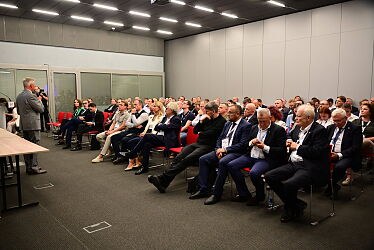
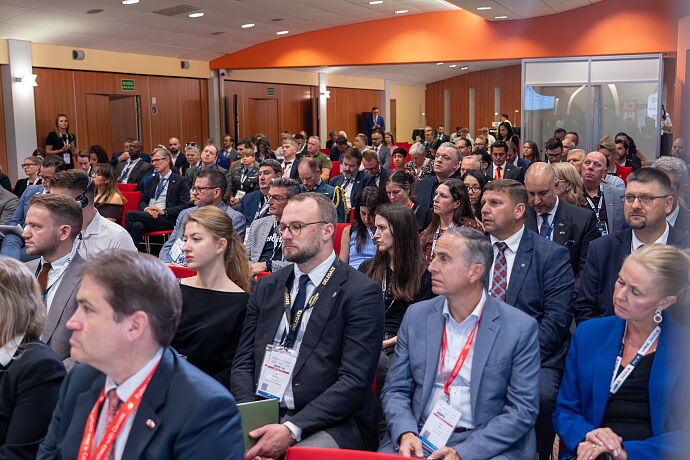
The scale of the Leading Country’s presence at this year’s International Defence Industry Exhibition was one of the main topics of the conference “Canada as a Trusted Defence Partner – Delivering Capabilities, Industrial Strength and Allied Security”. On Wednesday at Targi Kielce, representatives of government, the armed forces, industry and financial institutions from both countries discussed industrial cooperation, investment and the ability to scale up production for defence needs.
Wendy Hadwen, Deputy Assistant Deputy Minister for Policy at the Department of National Defence Investment Agency, highlighted the unprecedented scale of Canada’s representation in Kielce.
– “This is the largest presence of the Canadian government and industry at an international defence exhibition in our history,” she stressed.
Canadian companies have already signed just over 20 agreements with international partners during MSPO, including Polish businesses.
– “So it’s not just about contacts – it’s about contracts too,” Wendy Hadwen said.
A Partner, Not Just a Customer or Supplier
Kendal Hembroff, Associate Assistant Deputy Minister at Innovation, Science and Economic Development Canada, stressed that Canada’s presence in Kielce is not simply about showcasing its domestic defence industry, but above all about deepening cooperation with allies. In 2024, Canada’s defence sector contributed more than CAD 11 billion to GDP and supported more than 81,000 jobs, while the value of its exports reached approximately CAD 8 billion.
– “Industrial cooperation in the defence sector is no longer an option. It is a strategic necessity,” Kendal Hembroff said.
The partnership between Poland and Canada was also highlighted by Magdalena Sobkowiak-Czarnecka, Secretary of State at the Ministry of National Defence.
– “I really like the term ‘defence partner’. Not a customer, not a buyer, but a partner,” she stressed.
Konrad Gołota, Undersecretary of State at the Ministry of State Assets, in turn noted that the sheer size of the Canadian delegation demonstrated the country’s approach to this year’s Exhibition.
– “Because when you come to an exhibition like MSPO, you either come to talk about serious contracts, sign agreements, or make a few reels for social media. Sometimes you can tell from the size and scale of a particular delegation what they have come for. In your case, I don’t think there’s any doubt,” Konrad Gołota said.
As he pointed out, the political foundations for cooperation between the two countries are already in place. The next challenge is for industry to make the most of them.
– “The key issue now is how business responds: whether you seize this opportunity, whether you take the opportunity being put in front of you and leave here, if not with signed contracts straight away, then at least with a plan for cooperation,” he added.
The Polish Armed Forces Are Changing How They Prepare for War
The military dimension of the discussion was presented by Lt Gen Krzysztof Król, Assistant to the Chief of the General Staff of the Polish Armed Forces. As he stressed, the transformation of the Polish Armed Forces is not simply about replacing equipment. It also involves new technologies, organisational change and a shift in mindset – from the highest levels of command down to individual soldiers.
– “We are no longer preparing for expeditionary missions. We are preparing to conduct operations related to the defence of the Republic of Poland,” Lt Gen Krzysztof Król said.
Among the key areas of development, he identified the creation of a 500,000-strong armed forces, the development of air and missile defence, deep precision-strike capabilities, a new reserve system, unmanned technologies, robotics, automation and the use of artificial intelligence.
– “We are building deep precision-strike capabilities in the Armed Forces so that we, as Poles and as NATO, are able to determine when to de-escalate, rather than leaving that decision to those who attack us,” the general stressed.
Canada Is Turning Increasingly Towards Europe
The strong presence of Canadian companies at MSPO forms part of a broader increase in their activity on the European market. Julia Climie, Acting Director at Innovation, Science and Economic Development Canada, said that Canadian defence industry revenues exceeded CAD 17 billion in 2024, more than 85 per cent higher than a decade earlier.
Exports to Europe have grown even faster in recent years.
– “Canadian defence industry exports to Europe increased by almost 80 per cent between 2022 and 2024 alone,” Julia Climie said.
Canadian companies are developing technologies for the aerospace, maritime and land domains, as well as space systems, artificial intelligence, cyber security, quantum technologies, autonomous systems and dual-use solutions. Since the launch of its defence industrial strategy, the Canadian government has allocated more than CAD 2.1 billion to the development, commercialisation and scaling of such technologies.
Colin Barker, Executive Director of the Defence Exports Division at Global Affairs Canada, noted that the government is taking an increasingly active role in helping companies win international contracts – from arranging B2B meetings and facilitating contacts with government institutions to involving diplomatic missions and government representatives. At MSPO, dozens of Canadian companies are taking part in pre-arranged business meetings with Polish and international partners.
From Technology to Production Capacity
One of the strongest themes of the conference was industry’s ability to rapidly scale up production. Peter Dawe, Senior Vice-President for Defence Strategy at the Business Development Bank of Canada and a former Canadian Armed Forces officer, argued that having good technology alone is not enough.
– “The challenge facing Canadian SMEs is not innovation. It is readiness,” Peter Dawe said.
In his view, an enterprise’s value to the defence sector also depends on its ability to scale up production, meet demanding safety and quality standards, and maintain reliable supply chains. To support this, BDC has launched a CAD 6 billion defence platform combining financing, investment, advisory services and business development support.
Dawe stressed that defence readiness is built long before equipment is ever deployed – in factories, shipyards, laboratories and across entire supply chains.
– “Ultimately, readiness is not measured by what we intend to do, but by what we are actually able to deliver,” Peter Dawe concluded.


BB
Recommended articles