

SPACEFOREST SPÓŁKA Z OGRANICZONĄ ODPOWIEDZIALNOŚCIĄ
- ul. Bolesława Krzywoustego 1 B, 81-035 Gdynia, Poland
- 5832860098
- marcin.sarnowski@spaceforest.pl
- www.spaceforest.pl
Description
SpaceForest is a Polish deep-tech company developing advanced technologies for the space, defence and security sectors. The company combines strong expertise in radio-frequency engineering, microwave systems, signal processing, embedded electronics and rocket technologies to deliver reliable, mission-oriented solutions for demanding operational environments.
A key area of SpaceForest’s activity is radar technology. The company designs and develops radar systems and subsystems, including RF front ends, antennas, transmitters, receivers, power amplifiers and dedicated software for real-time detection, tracking and situational awareness. Its flagship radar product, HUSSAR, is designed to support effective object detection and monitoring in challenging conditions, providing users with improved awareness, faster decision-making and greater operational security.
SpaceForest’s solutions are developed with a strong focus on customer value. The company supports partners who require robust, adaptable and high-performance technologies for applications such as border surveillance, critical infrastructure protection, unmanned platforms, perimeter security, defence operations and space-related missions. Thanks to in-house engineering capabilities, rapid prototyping and testing, SpaceForest can tailor its systems to specific technical and operational requirements.
In addition to radar systems, SpaceForest is active in rocket technologies and suborbital platforms, strengthening its position as an innovative technology partner for advanced aerospace and dual-use projects. Its experience in complex engineering programmes enables the company to reduce technological risk, accelerate development cycles and provide solutions ready for practical deployment.
By combining radar expertise, space engineering and flexible product development, SpaceForest helps customers enhance situational awareness, improve mission effectiveness and access modern technologies designed for the needs of civil, security and defence markets.
A key area of SpaceForest’s activity is radar technology. The company designs and develops radar systems and subsystems, including RF front ends, antennas, transmitters, receivers, power amplifiers and dedicated software for real-time detection, tracking and situational awareness. Its flagship radar product, HUSSAR, is designed to support effective object detection and monitoring in challenging conditions, providing users with improved awareness, faster decision-making and greater operational security.
SpaceForest’s solutions are developed with a strong focus on customer value. The company supports partners who require robust, adaptable and high-performance technologies for applications such as border surveillance, critical infrastructure protection, unmanned platforms, perimeter security, defence operations and space-related missions. Thanks to in-house engineering capabilities, rapid prototyping and testing, SpaceForest can tailor its systems to specific technical and operational requirements.
In addition to radar systems, SpaceForest is active in rocket technologies and suborbital platforms, strengthening its position as an innovative technology partner for advanced aerospace and dual-use projects. Its experience in complex engineering programmes enables the company to reduce technological risk, accelerate development cycles and provide solutions ready for practical deployment.
By combining radar expertise, space engineering and flexible product development, SpaceForest helps customers enhance situational awareness, improve mission effectiveness and access modern technologies designed for the needs of civil, security and defence markets.
Products
HUSSAR
HUSSAR
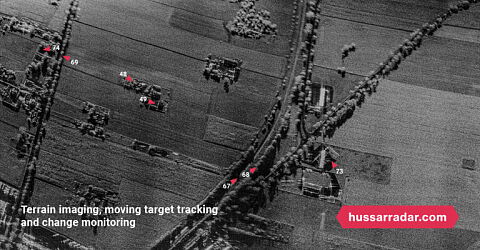
HUSSAR is SpaceForest’s flagship radar solution designed to enhance situational awareness, object detection and tracking in demanding operational environments. The system builds on the company’s expertise in RF technologies, microwave engineering, antennas, signal processing and dedicated radar software. HUSSAR can support applications such as critical infrastructure protection, border surveillance, perimeter security and unmanned systems. The project is being developed in cooperation with XY-Sensing, whose specialist expertise supports the development of advanced detection and signal analysis capabilities.
HUSSAR is a portable synthetic aperture radar for security, defence and area-monitoring applications. The system is based on RF and microwave technologies, digital signal processing and dedicated radar software. Its architecture enables mission-oriented configuration of operating parameters and integration with external command systems, C2/C4ISR platforms, electro-optical systems and sensor-fusion solutions. HUSSAR can operate as a stand-alone sensor or as part of a wider surveillance network. The design focuses on scalability, robustness in demanding environmental conditions, real-time operation and the ability to adapt communication interfaces to specific customer requirements.


PERUN suborbital launch system
PERUN suborbital launch system
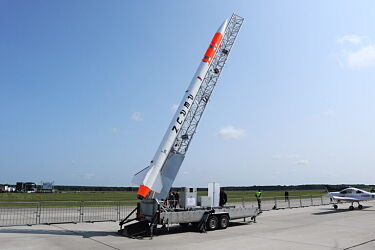
The PERUN suborbital rocket system consists of three key elements: the PERUN rocket, a dedicated launch platform, and the RASEL ground-support system. It is intended primarily for in-flight testing of on-board technologies, including avionics, sensors, telemetry, control systems, experimental payloads, and components requiring validation in real suborbital flight conditions.
The system provides a flexible platform for research and development missions, enabling rapid preparation, launch operations, and data collection. Due to its trajectory, performance characteristics, and operational adaptability, PERUN also has potential applications as a ballistic target imitator, supporting the evaluation, calibration, training, and verification of detection, tracking, and air and missile defence systems.
Configuration: single-stage, reusable suborbital rocket system
Rocket length: approx. 11–12 m
Body diameter: approx. 0.45 m
Lift-off mass: around 900–1,000 kg, depending on mission setup
Payload capacity: up to 50 kg for experimental payloads and on-board systems
Propulsion: hybrid rocket engine using liquid oxidizer and solid fuel
Thrust class: approx. 40–50 kN
Total impulse: in the high suborbital-class range, mission- and engine-configuration dependent
Flight profile: vertical or near-vertical suborbital trajectory, designed to reach high-altitude test conditions, with a target apogee of up to approx. 150 km
Velocity: supersonic flight regime, depending on payload mass and trajectory
Recovery: reusable architecture with parachute-based recovery of the rocket section and payload module
System elements: PERUN rocket, mobile launch platform, and RASEL ground-support system for launch preparation, monitoring, telemetry, and mission control.
Rocket length: approx. 11–12 m
Body diameter: approx. 0.45 m
Lift-off mass: around 900–1,000 kg, depending on mission setup
Payload capacity: up to 50 kg for experimental payloads and on-board systems
Propulsion: hybrid rocket engine using liquid oxidizer and solid fuel
Thrust class: approx. 40–50 kN
Total impulse: in the high suborbital-class range, mission- and engine-configuration dependent
Flight profile: vertical or near-vertical suborbital trajectory, designed to reach high-altitude test conditions, with a target apogee of up to approx. 150 km
Velocity: supersonic flight regime, depending on payload mass and trajectory
Recovery: reusable architecture with parachute-based recovery of the rocket section and payload module
System elements: PERUN rocket, mobile launch platform, and RASEL ground-support system for launch preparation, monitoring, telemetry, and mission control.

