News
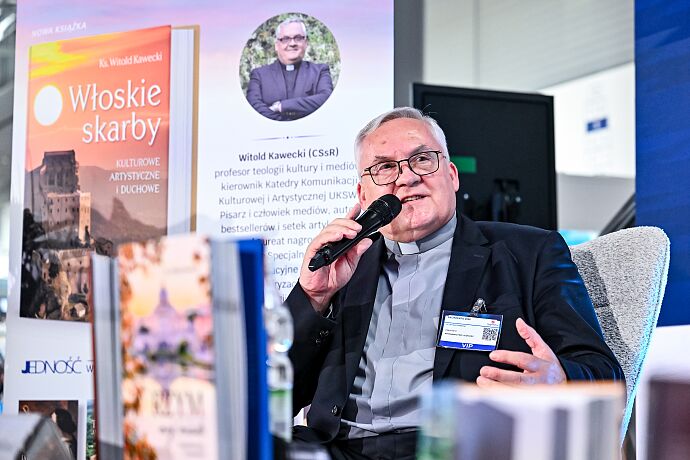
About Italian spirituality, art and the roots of Europe. Sacroexpo Featuring Fr. Professor Witold Kawecki
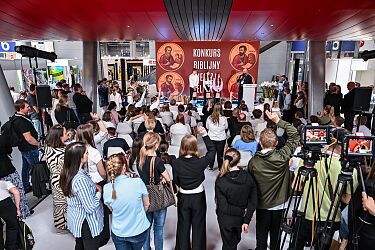
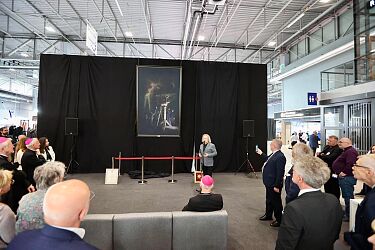
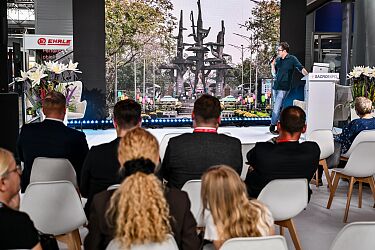
The conversation quickly moved beyond travel, participants had the opportunity to hear reflections on contemporary religiosity, the role of art in human life and the spiritual foundations of Europe.
One of the topics was Italian spirituality and its similarities and differences with Polish religiosity. Father Professor Kawecki pointed out that although Poles often perceive Italians as a nation particularly connected to the Church, their way of experiencing faith differs.
– Italian spirituality is more expressive, more visible in everyday life, but often also more superficial than Polish spirituality. We experience faith more deeply and reflectively, while they express it more often through emotions, gestures, tradition and culture, said the author.
at the meeting, the priest also debunked one of the most frequently repeated stereotypes about the inhabitants of Italy. As he emphasised, the belief in their exceptional openness is not always confirmed by reality.
– Italians are warm, smiling and communicative, but this does not mean that they are a very open society. In reality, they are quite distrustful and need time to really let someone into their world, he noted.
Much space was also devoted to art and its importance for contemporary man. When asked whether in the age of social media we can still truly look at works of art or whether we only photograph them, Rev. Prof. Kawecki emphasised that every encounter with beauty leaves a trace.
– Even if someone visits a museum or a church only for a moment, even if they take photos and move on, something from the experience stays with them. Art leaves a trace that can germinate years later. This builds our sensitivity, memory and identity, he said.
The author of "Italian Treasures" also recalled that the history of Europe is inextricably linked with Christianity. In his opinion, it is impossible to understand European culture, art or philosophy without reference to the faith that has shaped the continent for centuries.
– Without Christianity, there would be no Europe. The role of religion today may be assessed differently, but it cannot be denied that Christianity is embedded in our cultural DNA. It is present in the language, art, architecture, literature and way of thinking of Europeans, he emphasised.
The meeting was an opportunity not only to promote the book, but also to reflect on what modern people can find in travel, art and cultural heritage. As argued by Fr. Prof. Kawecki, the true treasures of Italy are not hidden only in museums and monuments, but also in experiences that help us better understand ourselves and our own roots.
"Italian Treasures" takes readers from Sicily, Matera and Apulia, through Umbria, Assisi and Perugia, to Ravenna, Brescia, Mantua and Turin, showing Italy not only as a cradle of art, but also a space where culture, history and spirituality meet.


Recommended articles