
News
Technology Should Work for Business. Transformacja 360° Forum Looks at Digitalisation, AI and Competitiveness
The Transformacja 360° Forum got under way on 22 September as part of Przemysłowa Jesień 2026. The event brought together representatives of industry, public administration, academia, technology companies and institutions supporting business development. Discussions focused on artificial intelligence, automation, robotics, data analysis, cybersecurity and investment financing. The event was opened by Grzegorz Orawiec from the Ministry of Development Funds and Regional Policy, Kielce Mayor Agata Wojda, Targi Kielce President Andrzej Mochoń and Kielce Technology Park Director Justyna Lichosik.
“Digitalisation should work for business, not the other way round,” stressed Justyna Lichosik. As she pointed out, artificial intelligence, automation and data analysis are not ends in themselves. Their purpose is to make companies more competitive, improve production efficiency and make better use of resources.
Poland Needs to Pick Up the Pace on Digitalisation
One of the Forum’s key themes was the gap between Polish businesses and more digitally advanced economies. According to data presented at the event, 8.4 per cent of Polish companies with at least ten employees used artificial intelligence in 2025. The EU average was above 20 per cent.
At the same time, only 19 per cent of companies had a digitalisation strategy, while 24 per cent had planned business processes related to its implementation. As many as 61 per cent of businesses were not using digital tools even to automate simple tasks.
Jolanta Jaworska, Director of Public and Regulatory Affairs at IBM Poland, the Baltic States and Ukraine, noted that digitalisation among Polish companies had accelerated partly as a result of the pandemic and new regulations. Skills shortages and a lack of organisational readiness, however, remain significant barriers. In her view, companies should not start by choosing a technology. They should first identify the business problem they want to solve.
Marek Lipka, Deputy President of the Polish Agency for Enterprise Development, highlighted the structure of the Polish economy, where microbusinesses and self-employed people make up a large share of the market. The needs of a small workshop are very different from those of a large factory implementing Industry 4.0 solutions. In every case, however, an investment needs to make economic sense.
The Money Is There. What’s Needed Is a Plan
Participants in the discussion pointed out that a lack of capital is not always the biggest obstacle to digitalisation.
“Paradoxically, funding is not the problem, because the money is there,” said Grzegorz Orawiec from the Ministry of Development Funds and Regional Policy.
As he explained, the bigger challenge can be a lack of knowledge, skills and a clear idea of how technology should actually be used. He outlined three levels of transformation: basic business digitalisation, process automation and robotics, and the most advanced applications of artificial intelligence. Companies can draw on both European funds and national financing instruments.
Experts stressed, however, that an application for funding cannot take the place of a strategy. A business should first define the result it wants to achieve – whether that means shorter production times, lower costs, improved quality, fewer errors or a new service.
AI Will Change Jobs, but Responsibility Will Remain with People
One of the Forum’s main highlights was a presentation by Professor Aleksandra Przegalińska. The researcher explored the impact of artificial intelligence on the labour market, productivity and the way businesses operate.
According to forecasts cited in her presentation, 170 million new jobs could be created worldwide by 2030, while 92 million could disappear. The overall balance could therefore be positive, but as many as 39 per cent of the skills required from workers may change.
The challenges could be particularly visible among people at the beginning of their careers. In occupations most exposed to the impact of AI, employment among workers aged 22–25 is already lower than in professions less susceptible to automation.
“If we stop hiring juniors, there won’t be any seniors either,” warned Professor Przegalińska.
She also highlighted the gap between what artificial intelligence is technically capable of doing and how widely it is actually being used by businesses.
“Just because something is technically possible does not mean it is being implemented,” she stressed.
Existing IT systems, process organisation, data security and unclear responsibility for decisions supported by algorithms can all stand in the way. The final assessment, verification and responsibility must ultimately remain with people.
AI can boost productivity, but the results are not the same in every industry or for every task. That is why companies should start with specific applications, measure the results, establish clear rules for using AI tools and train their employees. Another growing issue is “shadow AI” – employees using artificial intelligence tools without their employer’s knowledge and outside company procedures.
Start with the Problem, Then Choose the Technology
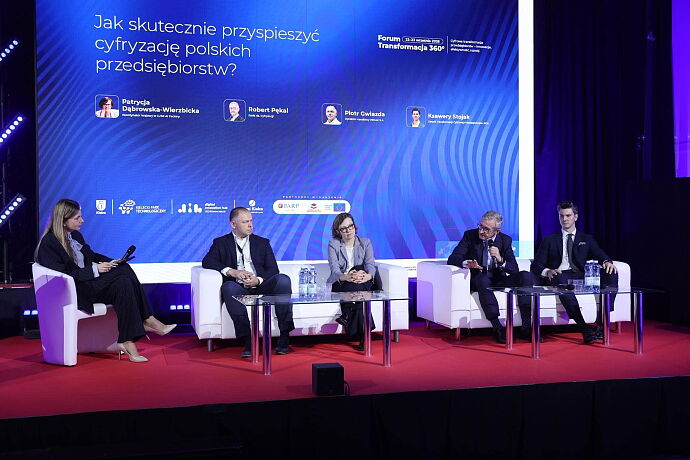
A panel devoted to practical implementation showed that digital transformation cannot simply end with the purchase of another system. Elżbieta Żuraw, a member of the Council for Digital Affairs and the Management Board of Polska Press Group, stressed the need to analyse processes in advance and assess an organisation’s digital culture. Only then can companies decide which tasks are worth automating and where AI can genuinely deliver value.
Professor Roman Deniziak of the Kielce University of Technology said a well-planned transformation should combine innovation with the creation of a genuine competitive advantage.
“Innovation should create competitiveness, and competitiveness should stem from innovation,” he said.
Rafał Chaba, President of Globtrak Polska, pointed out that there is no single transformation blueprint that will work for every company, municipality, university or institution. A technology provider can suggest solutions and draw on experience from other implementations, but it is the organisation itself that must know which problem it wants to solve.
Marcin Papros of Infover highlighted the importance of preparing a project properly and translating a company’s needs into specific implementation solutions.
Transformation Means Changing the Whole Organisation
The key message from the Forum’s first day was clear: technology is a tool, not the goal. Digitalisation affects processes, the division of responsibilities, employees’ skills and the way the entire business operates. Before embarking on an investment, a company should already know how it wants to operate once the transformation is complete.
The second day of the Forum takes an even more practical approach. The programme includes legal issues surrounding the use of AI, case studies of companies that have moved from identifying their needs to implementing technology, as well as discussions on prototyping, laboratories and testing solutions before committing to the full cost of an investment.
Participants can also visit the TK DIH Consultation Zone. Experts will help businesses assess their level of digital maturity, identify potential sources of funding and provide advice on automation, artificial intelligence, cybersecurity and advanced production technologies.
The Transformacja 360° Forum showed that the key question facing businesses is no longer “Should we go digital?” Today, it is “How can we manage the transformation so that technology delivers measurable results and genuinely strengthens the company’s competitiveness?” On Wednesday, 23 September, the Forum Transformacja 360° continues with further discussions under the theme “Digital Transformation of Businesses – Innovation, Efficiency, Growth”.
Recommended articles