News
One night doesn't mean it's allowed. Patryk Szlachciarski on wild camping in Europe
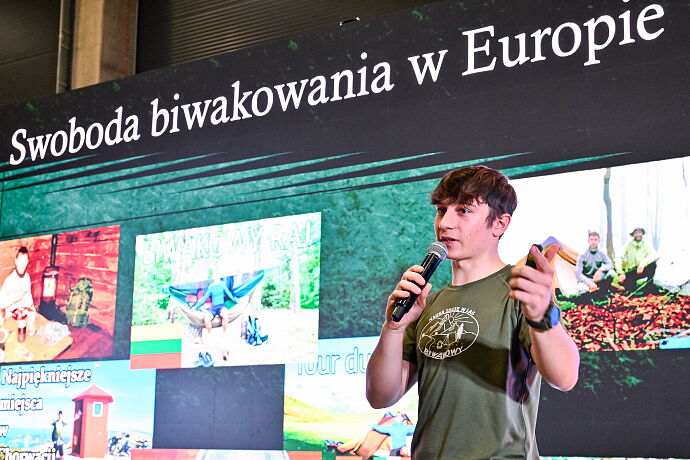
"The law is one thing; thinking logically is another," said Patryk Szlachciarski before going on stage at the Angling Festival.
The talk was about the legality of camping in Europe, but it soon became clear that this cannot be reduced to a simple map of countries where it is "allowed" and "not allowed". Szlachciarski knows these differences from his own expeditions across Norway, Sweden, Finland, Lithuania, Croatia, France and Italy.
One night doesn't give you free rein
One of the myths he debunked during the talk is the belief that if you only pitch your tent for a few hours, there is essentially no problem.
"Just pitching up for one night isn't OK everywhere," he stressed.
In his view, Scandinavia offers far more freedom. There, however, the right to enjoy nature goes hand in hand with responsibility for a place that someone else will be using next.
Szlachciarski described open-access huts where you can find a stove and firewood, and sometimes gas or a way to charge your phone. You use them, leave them tidy and move on.
The situation in Poland is different. The Biwakowy creator devoted his bachelor's dissertation to comparing Poland's "Spend the Night in the Forest" programme with Sweden's allemansrätten, the right of public access. As he pointed out, an area marked on a map tells you little about whether you can actually spend a comfortable night there. Within a designated zone there may be young plantations, wetlands or steep slopes.
Your own woodland? That doesn't mean anything goes
Another myth concerns private land.
"People think that a private forest in Poland is some kind of haven of freedom where you can do whatever you like. Absolutely not," said Szlachciarski.
This is particularly clear when it comes to fire. The mere fact that you are on private land does not remove the risks associated with drought or the possibility of starting a fire.
"If we light a campfire during a drought (…) and do it on peatland to boot, we're asking for a fine," he said.
This brings us back to his basic rule: before asking "Is it allowed?", it is also worth asking yourself "Is it actually sensible?"
At minus 30, the law stops being the biggest problem
Szlachciarski's experience goes far beyond a weekend night in the woods. On winter expeditions across Sweden and Finland, he faced temperatures plunging below minus 30 degrees.
At that point, even everyday tasks look different. Preparing a pitch for the tent takes a great deal of time and energy, camera batteries have to be kept close to the body, and an hour spent working on firewood can leave your feet seriously chilled if you stand still.
He described a stove in the tent not as a source of comfort but as an "insurance policy" – a way to warm up quickly or boil water when things start to get dangerous.
Because, contrary to what films might suggest, wild animals are not what he fears most on European expeditions.
"In Europe, wildlife isn't the biggest threat. I'd be more worried about the weather, conditions on the trail, people or feral dogs," he said.
A storm, getting soaked, freezing temperatures, illness or a poorly chosen camp spot can prove a far more real problem than an encounter with a wild animal.
On his expeditions, Szlachciarski has used mountain huts, slept in temperatures below minus 30, chosen tent pitches by reading contour lines on the map, and changed his plans many times when the weather or safety demanded it.
That is why his stories don't yield a simple list of countries where you can go camping. It is much easier to take away one rule: "allowed", "possible" and "sensible" do not always mean the same thing.
Patryk Szlachciarski arrived at the Angling Festival at Expo Kielce exactly as you might expect of the man behind Biwakowy – after a night in the woods near Opatów. As he spoke about the common sense you need in the wild, his wet tent was still drying out after yet another camp.
(BB)
Recommended articles