News
"Angling isn't really about the fish." Marek Szymański on the Vistula, technology and the chase for results
"The Vistula has always been my home," said Marek Szymański.
Over the years he travelled widely and also fished abroad. The trips gave him the chance to meet new people and discover new waters and techniques, but – as he admitted – he sometimes felt almost "dragged away by force" from his beloved river. Today he has a houseboat on the Vistula and spends several months a year there.
"I don't even need to catch the fish any more, honestly. Just being by this river gives me enough joy to keep doing it for the rest of my life, I hope," he said.
The Vistula is changing. So are the fish
The Mazovian stretch of the Vistula fascinates Szymański precisely because the river is always changing. Rising water and shifting currents can transform good swims, and the same species has to be fished in completely different ways in different places.
At the same time, today's Vistula is no longer the river it was fifteen or twenty years ago. Szymański pointed above all to the low water levels. In his view, they have made the river more readable and predictable, while the most interesting spots are constantly fished by many skilled anglers.
In the past, more water also meant more hidden spots that had to be found through experience and an "angler's nose". Today the fish are under greater pressure, but that does not mean they have disappeared.
Zander are a good example. Szymański watches young anglers who, in late autumn, don't start fishing until around midnight. If they hit a feeding window, they can regularly achieve excellent results. In his view, the fish have learnt to dodge pressure just as effectively as anglers try to outwit them.
Live sonar? Not everyone wants the answer straight away
Szymański has never been one to chase the latest trends. To this day he does not fish with live sonar. Not because he doubts how effective the new technology is.
What he enjoys is precisely not knowing everything.
He has to read the water, draw conclusions and work out where the fish might be. It is a part of angling he has no wish to give up.
"The point is to fish in a way that feels fun to us," he said.
He takes a similar view of the pursuit of records.
"Centimetres have never mattered to me. At one time I didn't measure my fish at all. I had no need to," he admitted.
Social media has changed this aspect of angling too. A photo of a fish increasingly comes with a precise length and a comparison of catches. Szymański does not dismiss this way of enjoying the hobby, but his own satisfaction has never depended on landing a "90-plus" or "100-plus" fish or breaking yet another record.
When knowledge had to be wrested from the water
What he misses most is the time when angling offered a greater sense of discovery.
In the 1990s there was no internet, no social media and no thousands of how-to videos. Information reached anglers through the press and by word of mouth. Even if someone discovered an effective technique on their own water, it could take a long time before it became widely known.
"Some things you had to wrest from the water with your bare hands, because nobody wrote about them and the knowledge just wasn't out there," he recalled.
He himself was one of those who shared that knowledge. He made use of the opportunities offered by the angling press, writing among other things about how to read a big river.
So his nostalgia for the age of discovery is not nostalgia for keeping knowledge to oneself. Szymański notes that even the best idea will sooner or later occur to someone else too. There are too many anglers watching the water and experimenting for the development of techniques to be held back.
A father teaches his son. And then starts learning from him
Knowledge also passes between generations.
Marek's son, Szymon, was taken on demanding trips from early childhood. He fished for catfish and sea trout with his father, covered miles along the river in winter and learnt about angling first and foremost through practice.
Over time, however, the master–apprentice relationship stopped working in one direction only.
Marek admitted that it was his son who taught him a more effective way of catching fresh-run sea trout. Szymon worked the lure faster and higher in the water, while his father stuck to his old habits. The younger angler's method turned out to work better.
So Szymański began watching his own son closely.
It sums up his attitude to experience: decades by the water do not mean you stop learning.
"Angling isn't really about the fish"
He heard these words from his mentor many years ago.
Today he admits that he understands them better and better. The catch still matters, because every angler wants to feel a bite and land a fish. But it need not decide whether a trip has been a success.
His own angling has changed, too. He once thought nothing of spending twelve hours on the road each way just to fish for a few hours. Today he says himself that he no longer has the same "oomph".
Yet some things have not changed. In winter he returns to the sea and the salmon; in summer, to the Vistula. He still reads the water, looks for new answers and keeps learning – sometimes from the river, sometimes from other anglers and sometimes from his own son.
And perhaps that is why, after all these years, he no longer needs to prove his passion in centimetres.
Being able to return to the Vistula is enough.
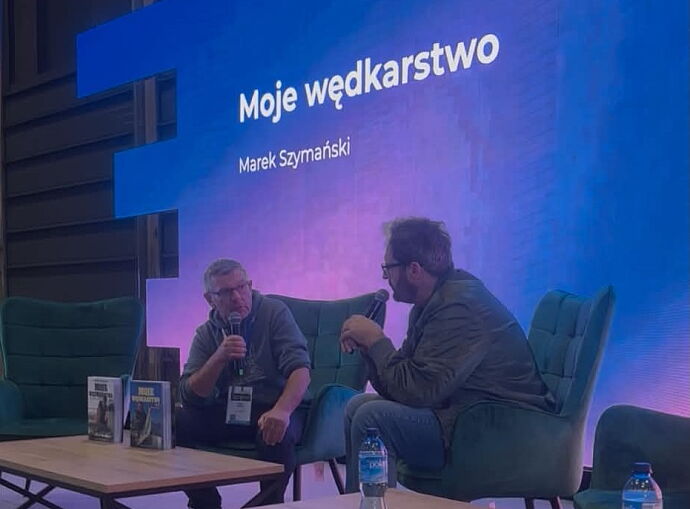
Marek Szymański was a guest at the Angling and Survival Festival at Expo Kielce. His talk, "My Angling", formed part of the programme of an event devoted to people, experiences and passions connected with water and the outdoors.
(BB)
Recommended articles