News
Minister Miłosz Motyka: Poland knows what it wants. Nuclear and renewable energy sources are the foundation of the new energy mix
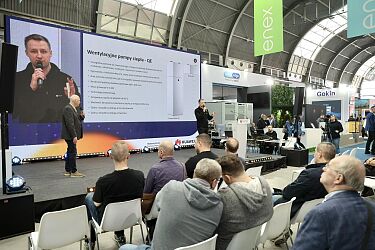
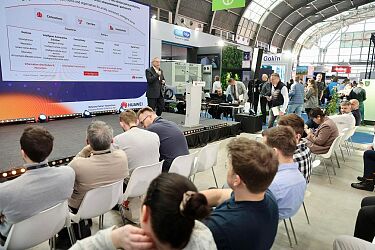
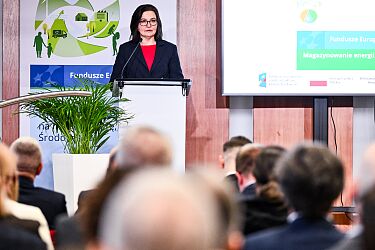
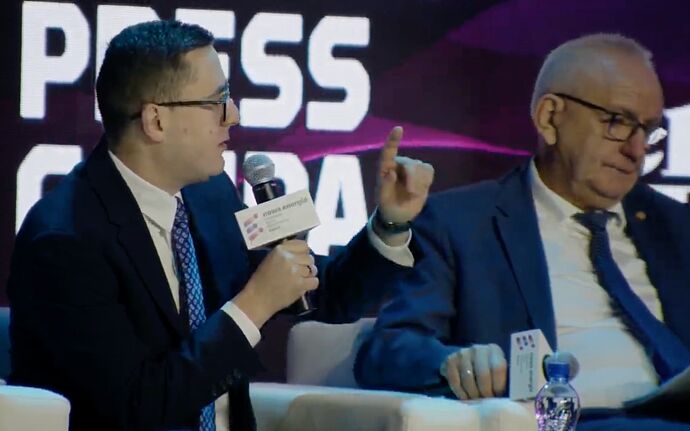
At Targi Kielce, during the New Energy Regional Economic Forum Kielce 2025, a panel entitled "Polish energy strategy – what share of traditional sources, what share of green energy: wind, solar and others, and what share of nuclear energy?" was held. Representatives of business and industry organisations sat alongside the Minister of Energy, Miłosz Motyka: Kamil Suchański, chairman of the supervisory board of Ekobox, Krzysztof Jamróz, vice-president of ZPUE, Professor Mirosław Malinowski from Chemar Rurociągi and Maciej Drozd, director of regulations at the Polish Chamber of Energy Storage and Electromobility. The discussion quickly moved from journalistic generalities to specifics: mix, costs, networks and security.
Minister Miłosz Motyka began with a strong statement: Poland knows what it wants in its energy mix. In the long term, nuclear energy is to form the basis of the system, closely cooperating with renewable energy sources – offshore wind farms, developing onshore wind energy and photovoltaics. Until around 2050, gas is expected to serve as a transition fuel, but in parallel, as he noted, the role of energy storage will grow, enabling the integration of an increasing volume of unstable sources.
Minister Miłosz Motyka recalled that just a dozen or so years ago, it was difficult to imagine the scale of prosumer energy development observed in Poland today. The photovoltaic boom and falling technology costs are meant to be proof that the transformation is taking place primarily because it is economically viable, and not just because it is regulatory-enforced. – We didn’t install solar panels on our roofs because we liked Brussels’ climate goals, but because it simply pays off – the minister emphasised.
When asked about the influence of the "coal lobby" on the pace of change, the head of the Ministry of Energy avoided simple opposition and he pointed out that the problem is not the strength of the lobby. Still, the structure of power in the system – on days with low generation from renewable energy sources, available coal-fired power units are still needed. At the same time, he noted that new coal-fired power units are no longer being built in Europe, and the key challenge today is not the installed capacity itself, but the social dimension of the transformation. Voluntary redundancy programs, utilizing the competences of employees of power plants and mines, and avoiding the "second Wałbrzych" scenario – these are, in his opinion, the conditions for the success of changes in regions such as Silesia, Turów, and Bełchatów.
From a business perspective, however, the picture is not so optimistic when it comes to basic infrastructure. – As a country, we are significantly behind when it comes to investments in transmission and distribution grids, as assessed by Krzysztof Jamróz from ZPUE. He recalled that a significant portion of overhead lines are now over 60 years old, and the effects of years of neglect are visible with every major weather breakdown. – The scale of investment has really only just begun - only this year that we are experiencing a real increase in orders for energy distribution equipment, he said. As he emphasised, without modernising the grid and integrating renewable energy sources, there is no chance for either cheaper energy or lasting energy security.
Energy storage was presented at the panel as one of the key elements of the new system. Maciej Drozd recalled that in 2024, the system had only 25 MW of energy storage capacity, while over 30 GW is planned for the 2030s. – This is growth that is not seen in any other segment – he emphasised, emphasising that storage facilities do not compete with renewable energy sources, but complement them, enabling the balancing of surpluses and ensuring grid stability. He also drew attention to the growing importance of green energy for the economy's competitiveness, which increasingly depends on the ability to use energy with a low carbon footprint.
However, a representative of the storage industry criticised the proposed changes to the capacity market, in which storage facilities – due to their low “availability factor” – are pushed to the margins compared to gas and coal-fired units. In response, Minister Miłosz Motyka stressed that the capacity market was from the outset a transitional mechanism, designed for dispatchable units, and not a target support system for all technologies. He declared that the development of storage facilities should be supported through regulations, National Environmental Protection Fund programs, and changes to construction law, rather than necessarily through the capacity market.
The head of the Ministry of Energy used this thread to warn against overly easy promises of reductions in transmission and infrastructure fees. – Money on the grid doesn’t come from trees or banks – he said, pointing out that limiting operators' revenues must mean a lower level of investment. According to Minister Miłosz Motyka, the key is to shape the system in such a way that it simultaneously reduces energy prices for consumers and maintains the multi-year grid modernisation program, which is expected to reach approximately PLN 100 billion by 2030.
Kamil Suchański drew attention to another dimension of the transformation – the scale and pace of the necessary changes. Poland currently produces less than 170 TWh of energy per year. Replacing oil in the transport sector would require, as he estimated, an additional approx. 300 TWh of electricity, and moving away from gas could require generating another 200 TWh. – Our transmission grids, whose basic framework is often 60 years old, must be prepared to transmit more than twice the volume of energy than today – he said.
Kamil Suchański also recalled that energy security is not only about power and networks, but also about raw materials. Poland has only a fraction of its own oil resources and limited gas resources, while wind and solar energy are, once the appropriate infrastructure is installed, independent of imports. In this context, he also recalled Ukraine's experience, where the power system is maintained because nuclear power plants were not the aggressor's main target, and the importance of distributed generation for the country's resilience in crises.
A relatively consistent message is emerging from Kielce: the Polish energy transformation is to be based on a strong nuclear component, a dynamically growing role for renewable energy sources and energy storage, and a simultaneous, gradual evolution in the roles of coal and gas.


Recommended articles